
My Life in a Min Pin World
July 13, 2017
canine colitis, HGE, Metronidazole, Miniature Pinscher, Tylan Leave a comment
Aspen has blood coming out of her butt. I had just come out of a Starbucks about thirty-five minutes from home when my husband called to deliver this alarming news. Trying to remain calm, I told him that I would be there as quickly as possible and to have Aspen ready to go the emergency veterinarian hospital. It was Sunday, of course, and our regular vet was closed. The drive home seemed endless and I tried to avoid imagining worst case scenarios which proved to be a difficult task.
When I arrived home Aspen was no longer bleeding and seemed fine which slightly eased my worries. The hour-long drive to the hospital appeared to be a carefree ride in the car for Aspen as she showed no signs of being ill.
At the hospital Aspen was examined by a vet and a blood sample was taken. In a short amount of time our eighteen month old dog was diagnosed with hemorrhagic gastroenteritis.
Hemorrhagic gastroenteritis, also known as HGE, is an acute illness that can become life threatening in a short time if not treated immediately. The chief symptom of HGE is bloody diarrhea, ranging from bright red drops to a “raspberry jam” consistency. Dogs suffering from HGE may also exhibit vomiting, with or without blood, and lethargy.
Although HGE has been diagnosed in large dogs, it is more commonly seen in toy and small breed dogs. Veterinarians are not sure what causes this illness, but theories include bacterial infections, parasites, food allergies, and/or stress.
Fortunately, Aspen’s HGE was caught in a very early stage. Since that first episode, both Aspen and Malibu have had multiple bouts of HGE, with some cases being mild and others more serious. Several cases have required overnight hospitalization, but usually an IV fluid treatment and medication is all that is necessary. Metronidazole is prescribed and given for a week or two.
At some point in time, it was recommended that we change Aspen’s diet to Hill’s Prescription i/d. This particular food is given to “promote gastrointestinal health”. A couple of years later, after another HGE episode, Aspen was switched to a different Hill’s formula. Believing that her HGE may be caused by a food allergy, Aspen’s vet prescribed z/d, which is hypoallergenic. We gave it a try even though I did not feel that the HGE was caused by Aspen’s diet. If the food Aspen was eating was causing the issue, she would have had symptoms more than a few times a year. Finally, we returned Aspen to her original diet, Wellness.
Despite the clinical symptoms of HGE lasting only a few days, a couple of Aspen’s bouts led to significant weight loss over the months following her illness. The reason for this is unknown.

The last HGE episode that required a visit to the vet for Aspen was about a year ago. The vet recommended that Aspen remain on the Metronidazole indefinitely, but I was not in agreement.
Seeking a second opinion I scheduled an appointment with a veterinarian gastroenterologist. The doctor provided me with additional information about HGE and stated that she does not consider it a disease, but rather a symptom of a disease. Lab work was ordered to rule out Addison’s Disease and Maldigestion disorder. Test results were negative and Aspen was diagnosed with chronic, intermittent colitis. Like Aspen’s regular vet, the specialist recommended that an antibiotic be given indefinitely.
Tylan was prescribed rather than Metronidazole with the goal of using the lowest dose needed to avoid symptoms. In June of 2016 Aspen began taking two Tylan capsules a day. By December of that year she had been weaned to one capsule every third day. That did not last long because Aspen’s symptoms returned and the dosage was increased to one capsule a day. Last month I lowered the dosage to one capsule every other day.
I recently began giving my dogs probiotics with the hopes of preventing future episodes of HGE. Not everyone agrees that probiotics are worth the expense, but some tout the many benefits of giving them to our pets. “Boosting your dog’s immune system is probably the most important role of probiotics”, states Dogs Naturally Magazine. They add that, “A good balance of probiotics helps reduce inflammation throughout your dog’s body and that lowers their susceptibility to chronic disease.”
Although HGE can be a serious and life-threatening illness, I have been fortunate enough to identify its earliest symptoms in my dogs and seek treatment. Not knowing the exact cause of HGE is frustrating. Perhaps there are multiple causes, not just one. The important thing is treating it when it does happen.
Update – August 11, 2017
Quest, my Min Pin who has never required medical treatment for HGE, spent a few days in an animal emergency hospital last week. The diagnosis: hemorrhagic gastroenteritis. What began as gurgle guts and attempts at grass grazing on a Saturday morning transitioned to bloody diarrhea and vomiting in the predawn hours of Sunday. Off to the hospital we went. Initially, Quest was given fluids and sent home with Metronidazole, Panacur, and cans of Hill’s i/d.
By Sunday evening Quest was sicker, having episodes of bloody diarrhea every thirty minutes and exhibiting pain, so we returned to the hospital. Quest was admitted as we tried to figure out what caused her to get sick. She was sicker with HGE than my other two have ever been, and once again, we had no answers.

Visiting Quest in the hospital
Fortunately, Quest appears to have completely recovered from this mysterious illness. She completed her medications earlier this week and has resumed her regular diet.
With Quest’s recent ordeal, I have more questions about HGE that will go unanswered. In addition, I now firmly believe that genetics plays a role in this illness. Aspen and Malibu have been dealing with HGE for years, but somehow Quest was able to avoid it until now. My husband and I often joke that Quest has a cast-iron stomach, but I guess we will not be saying that anymore because Quest just became a member of the HGE club.
December 24, 2016
October 15, 2016
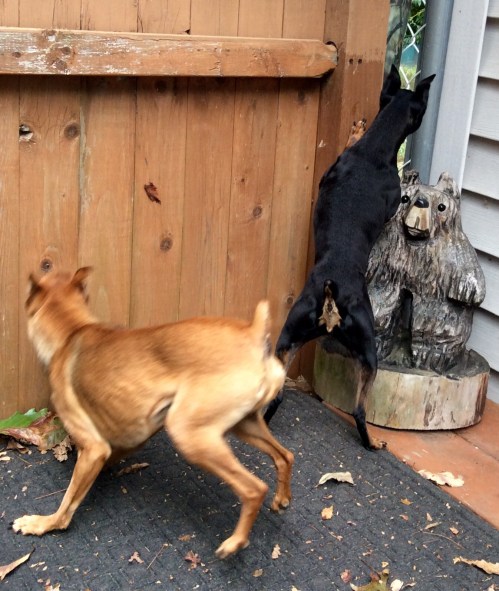
Quest says, “I’ll peek first.”

Then we will peek together.
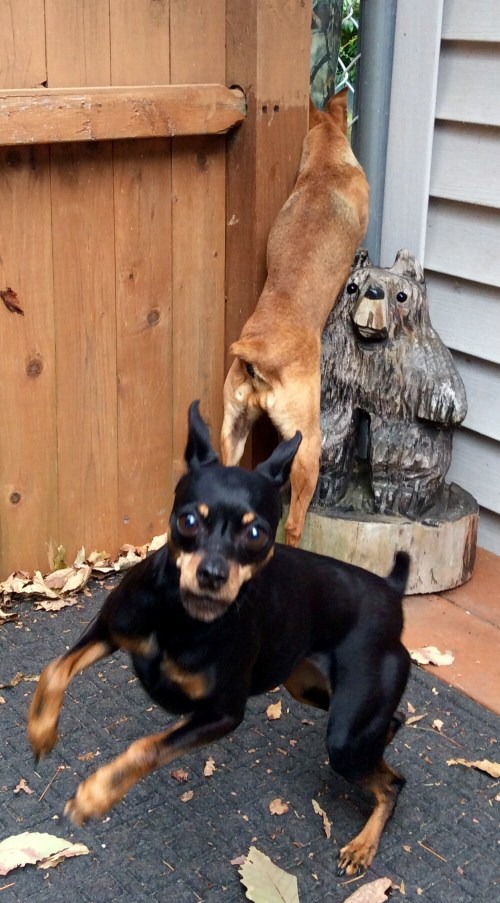
Then Aspen can peek while I tell Mom what is on the other side of the fence.
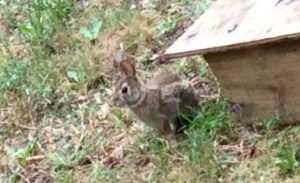
“Do you think Mom will let us keep him?”
August 15, 2016
Miniature Pinscher, Summer Olympics 2016 Leave a comment
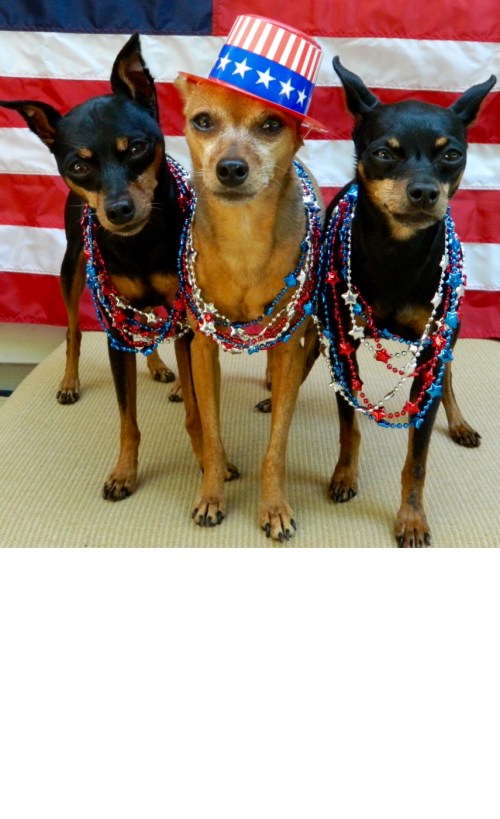
Team USA
August 7, 2016
Uncategorized dog agility, Miniature Pinscher puppies Leave a comment
Miniature Pinschers are well-known for their high energy, perpetually-in-motion personalities, and my girls are no exception. When my crew was about six months old I realized that I needed to find activities that cater to their active lifestyle. Paging through a dog catalog, I spotted an agility starter kit that included a tunnel, bar jump, and some weave poles. It looked interesting and fun so I ordered it. Maybe it would provide an outlet for my girls’ boundless energy.
Since it was summertime I was home every day and the girls and I would spend most of our time in the backyard. As soon as the agility set arrived I wasted no time setting up the equipment. No coaxing or training was needed for the tunnel. What puppy doesn’t love running through a tunnel?
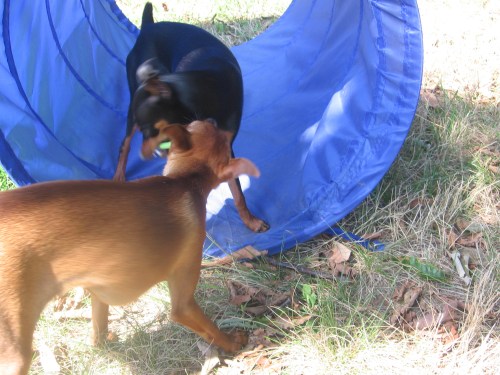
Aspen & Malibu
It was no surprise that the girls were good at clearing the bar jump that came with the set. Min Pins are natural jumpers and have the ability to leap incredibly high. Being careful and using good judgement when encouraging my girls to jump over the bar, I kept it very close to the ground. After all, they were still puppies.
The weave poles were the only part of the set that I would need to teach. There are various ways to teach weave poles, but I was new to this sport and not familiar with any specific techniques. I used my own approach, one I call the Cheerio method. I taught my girls how to weave by luring them in and out of the poles with Cheerios. The girls picked up this new skill quickly and before long they were weaving through the six poles without needing the lure of Cheerios.
The following spring I was curious to see if there were any agility classes nearby. The closest facility was about forty-five minutes away. I wished it were closer, but decided to register for a beginner class anyway. Which Min Pin would be enrolled? Quest was too reactive to be in a class setting with other dogs and Aspen had recently experienced a health issue, so Malibu was the lucky dog.
I was excited to attend the first class and hoped that Malibu would not be reactive towards the other dogs. There were about five dogs in the class, including Malibu. The instructor began class with some targeting and focusing activities. I wanted to begin working on the agility equipment, but realized that I needed to be patient.
For the most part, Malibu was fine with the other dogs which was a huge relief. As long as I kept some distance between her and the other dogs, she did not seem to be stressed by the environment. I was disappointed when our time was up and looked forward to the next class.
That first class was the beginning of Malibu’s agility “career”. We have had ups and downs and made lifelong friendships with other agility enthusiasts that we have met along the way.
Malibu and her best agility buddy, Charlie
July 26, 2016
Uncategorized Miniature Pinschers, multiple dog household Leave a comment

There are those that follow rules and those who break them. Malibu seems to be saying, “I’m next, Quest. Get on line behind me!”
April 9, 2016
Uncategorized Animal communicator, Canine anxiety, Clomicalm, Dr. Karen Overall, Gabapentin, hyper-reactive Miniature Pinscher, Lydia Hiby, milk thistle, valerian Leave a comment

Quest
A few months ago I consulted with Lydia Hiby, an animal communicator, with the hopes of getting some long-awaited answers about Quest’s hyper-reactive behavior. Unfortunately, I am no closer to understanding Quest than I was before. I had truly hoped that Ms. Hiby would provide me with significant information, the missing puzzle piece, that would shed light on Quest’s behavior, but that did not happen.
Ms. Hiby’s recommendation of herbal remedies for Quest’s issues was something that I had not anticipated, but worthy of consideration. I had some knowledge of valerian from my ongoing research about canine anxiety, but was unfamiliar with milk thistle. I wasted no time investigating that particular herb.
According to the Whole Dog Journal, milk thistle is “best reserved as a treatment for existing liver disease, rather than being used by itself in a healthy dog.” The article goes on to state that long-term ingestion of very high doses will eventually suppress liver function. Well, that is problematic. First, I do not believe that Quest has liver disease. Although Ms. Hiby felt that Quest’s liver is “out of balance”, that does not mean that Quest has anything physically wrong with her liver. With no symptoms, I cannot bring myself to schedule a veterinarian appointment for Quest and ask the doctor to check Quest’s liver based on an animal communicator’s intuition. Maybe I am more of a skeptic than I thought. Secondly, if I decided to have an open mind and give the milk thistle a try, without a veterinarian on board I would have no way of knowing the proper dosage to give a 6 lb. dog. Milk thistle was officially off the table.
As for the valerian, I wanted to check with Quest’s veterinary behaviorist, Dr. Overall, and get her opinion. Since Quest was currently taking Gabapentin I knew that care must be used when combining herbal treatments with prescription medications. Dr. Overall informed me that she used to recommend valerian for anxious dogs years ago before today’s commonly used drugs were affordable, but she never saw the effect that is observed with pharmaceuticals. She added that a drawback to using herbal remedies, like valerian, is that we don’t know how much of the main ingredient is in any of these compounds. So, valerian was off the table, too.
Although I did not feel that it was safe to follow Lydia’s advice about the homeopathic remedies, my conversation with her did prompt me to seek a change in Quest’s current medication. After consulting with Dr. Overall, Quest was weaned off of the Gabapentin and began Clomicalm(clomipramine). Clomicalm, like many pet medications, was adapted from a human drug. It is categorized as an SSRI(selective serotonin reuptake inhibitor), and similar to the human anti-depressant, Prozac.
Quest was on the Clomicalm for a couple of months and exhibited the same level of anxiety that has always been present. Dr. Overall recommended increasing the dosage, but there was a conflict. Quest was due for a dental cleaning which required anesthesia. Quest’s regular veterinarian was not comfortable performing the procedure while Quest was taking Clomicalm, even though Dr. Overall gave her approval. With safety being my top concern, I weaned Quest off of the Clomicalm so that she could have the dental cleaning.
Quest has been drug free for over three months now. I decided to take a “wait and see” approach before beginning the Clomicalm again with the recommended dosage increase if needed, or asking about trying a different drug. Lately, I have heard Quest gritting her teeth, a sound I have not heard in a while, and have also noticed a bit more nibbling on her front legs. Sigh.
It would be so much easier to make a decision if Quest could speak. I would ask her, “How is your anxiety?” “Was it better when you were taking medication?” “Which medication helped you the most?” “Please tell me what I should do.” Since Quest is unable to answer those questions it is up to me, and me alone, to decide how to proceed.








 minpinmoments
 MinPinMoments